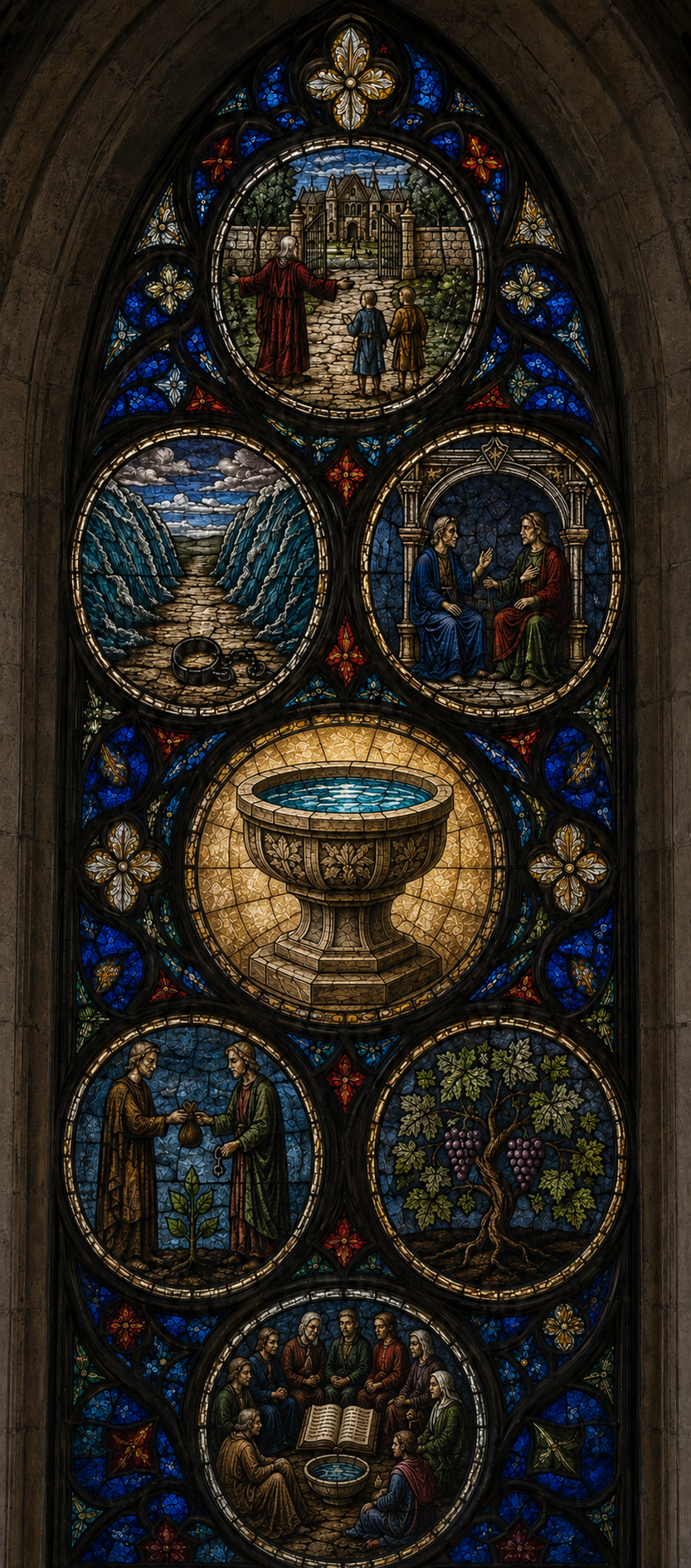
Why grace precedes, sustains and transforms human response
Grace First proposes a simple liturgical experiment: in a movement of corporate confession, speak an actual Assurance of Forgiveness before the Prayer of Confession. The proposal arises from a central Reformed conviction—God acts with grace, and human faith, repentance and obedience are responses enabled by God.
This page explains the theology beneath the experiment. It also names the limits of the historical argument. Grace First does not claim that Calvin, the Reformed confessions or historic Presbyterian liturgies placed assurance before confession. They generally did not. Nor does it claim that the customary Presbyterian order is devoid of grace. The current Directory for Worship explicitly grounds confession in the promise and initiative of God.
The question is constructive rather than antiquarian: If our theology says that God’s favor is not produced by our repentance, might an occasional reversal of the customary sequence help the church inhabit that truth more fully?
The biblical grammar of divine initiative
The phrase “grace comes first” is not a claim that every biblical narrative follows one visible chronology. Scripture includes calls to repent, warnings of judgment, prayers for mercy and covenantal conditions. The biblical witness cannot be reduced to a single slogan.
Nevertheless, a broad theological pattern is unmistakable. God creates a world that does not create itself. God calls to humanity in hiding. God covenants with Abraham before Abraham can establish the promise. God hears Israel’s cry, brings the people out of Egypt and then gives the commandments. The prophets promise that God will gather, cleanse and give a new heart. In the New Testament, God comes to us in Jesus Christ; Christ dies for us while we are sinners; the Spirit gives life to those described as dead in sin. Divine action awakens and sustains human response.[1]
Exodus 20 offers one of the clearest liturgical grammars. The commandments begin with God’s identity and action: the Lord is the God who brought Israel out of slavery. The people are commanded to live as God’s covenant people because God has already liberated them. Obedience is neither optional nor the cause of liberation. It is the form of grateful freedom.
Romans 5:6–11 sharpens the same pattern around Christ. Paul describes Christ dying for the ungodly while they are weak and still sinners. Ephesians 2 holds divine initiative and transformed life together: salvation is God’s gift, not a ground for boasting, and those made alive in Christ are created for good works. Grace does not compete with faithful action. Grace creates it.[2]
The New Testament also portrays God’s purpose in Christ as deeper than a last-minute reaction to human failure. Ephesians 1:3–10, 2 Timothy 1:9–10 and 1 Peter 1:18–21 locate God’s purpose in Christ before our response and, in different ways, before the foundation of the world. Grace First sometimes summarizes this by saying, “Jesus is not Plan B.” That is our contemporary summary, not a quotation from Calvin, James Torrance or Andrew Purves. It does not settle the debated question of whether the incarnation would have occurred apart from the fall. It makes the more modest claim that Scripture does not portray God as surprised into improvising redemption.
Grace and repentance in the Reformed confessions
The Scots Confession gives the Holy Spirit decisive agency in faith, regeneration and sanctification. Chapter 12 says faith and assurance do not arise from natural powers but from the Spirit’s work. Chapter 13 compares this work with creation and redemption: as humanity cannot claim credit for being created or redeemed, it cannot claim credit for regeneration and sanctification. The same chapter expects struggle against sin and earnest repentance, but attributes these to the power of Jesus Christ rather than autonomous human capacity.[3]
The Heidelberg Catechism begins with comfort. Its first answer does not begin with what the Christian has achieved but with belonging to Jesus Christ, whose Spirit gives assurance and makes the believer willing and ready to live for him. Question 2 then names three things needed to live and die in this comfort: knowledge of sin and misery, deliverance, and gratitude. Heidelberg therefore does not erase the seriousness of sin or provide a direct liturgical order for Grace First. Its pedagogical structure is often described as guilt, grace and gratitude. Yet the entire catechism is framed by the prior comfort announced in Question 1.[4]
Heidelberg’s later questions reinforce the relationship between gift and response. Question 60 says that righteousness before God is received through faith in Jesus Christ even while conscience accuses. Question 73 describes baptism as a divine pledge and sign meant to assure believers of cleansing in Christ. Question 86 asks why people delivered by grace should do good works and answers that Christ, having redeemed them, is restoring them by the Spirit. Gratitude and transformation follow deliverance; they do not purchase it.[5]
The Westminster Confession requires additional care. It describes justification as God’s free act of pardon in Christ, received by faith, and insists that faith itself is God’s gift. It also says that saving faith is never alone but works through love. In its chapter on repentance, Westminster calls repentance “an evangelical grace.” Repentance is necessary and includes grief over sin, turning toward God and concrete new obedience. Yet repentance is not a satisfaction for sin or the cause of pardon; pardon remains an act of God’s free grace in Christ.[6]
These confessions do not say that the church should announce forgiveness before every confession. They do establish the theological distinction on which the experiment depends: repentance is a real and necessary human response, but it is not a work that makes God gracious. The Spirit creates and sustains the response to grace.
Calvin: theology, pastoral criteria and actual order
Calvin supplies strong theological support for grace preceding repentance, but his actual liturgical order must be represented honestly.
In Institutes 3.3.1–2, Calvin argues that repentance follows faith and is produced by it. He immediately refuses any separation of forgiveness from new life. A person cannot embrace the grace of the gospel without turning from the former way of life. His point is not that repentance can be postponed indefinitely, but that repentance cannot become the condition by which a person manufactures God’s favor. Calvin says a person cannot seriously engage in repentance without knowing that they belong to God and embracing God’s offered favor. He interprets the gospel summons to repent as a consequence of the announced nearness of God’s reign.[7]
Calvin also treats repentance as God’s gift. In Institutes 3.3.21, he appeals to Acts 11:18 and 2 Timothy 2:25 to describe repentance as granted by God through the Spirit of regeneration. Again, this does not diminish human turning. It locates that turning within divine action.
Calvin valued public confession and absolution. In Institutes 3.4.10–14, he commends corporate confession in the church’s assembly and the proclamation of pardon as a pastoral exercise of the gospel’s promise. His surviving liturgical forms, however, place confession before absolution. The forms associated with Strasbourg and Geneva therefore do not offer an historical example of the sequence Grace First proposes.[8]
There are also differences between Calvin’s Strasbourg and Genevan circumstances that should not be flattened. Calvin’s French-speaking Strasbourg liturgy developed under the influence of Martin Bucer and included a declaration of absolution after confession. In Geneva, Calvin desired an absolution, but the Genevan form did not contain the same pronounced formula. Historical summaries sometimes merge the two orders into one generalized “Calvin service.” For the narrow purpose of this project, the secure conclusion is simpler: confession preceded whatever assurance or absolution followed; assurance-before-confession is not a retrieval of Calvin’s order.[9]
Why, then, appeal to Calvin? Not because he stated a general rule that every element of worship must be immediately clear, and not because he endorsed the sequence proposed here. His claims are more specific. Calvin required public prayer to be offered in a language the people could understand because public prayer is for the edification of the whole church (Institutes 3.20.33). When discussing ecclesiastical ceremonies and arrangements, he appealed to Paul’s concern for decency and order. Such arrangements are not necessary to salvation; they must be governed by Scripture’s general rules, serve the church’s common life and cultivate rather than obstruct piety (Institutes 4.10.27–32).[10]
The responsible inference is limited but important. Calvin’s theology says that God’s offered favor gives rise to repentance, while his treatment of public prayer and church order attends to understanding and edification. Taken together, these commitments give contemporary Christians reason to ask whether an inherited sequence is communicating the gospel as clearly as it might. That is a constructive application of Calvin’s criteria, not a conclusion Calvin drew and not proof that he would have approved this particular experiment.
The current Presbyterian order already begins from grace
The 2025–2027 Book of Order states the theological rhythm with unusual clarity: “God acts with grace; we respond with gratitude” (W-1.0102). It describes this pattern of divine action and human response as a rhythm found throughout Scripture and central to Reformed faith and worship. The same chapter says that the Holy Spirit manifests God’s gracious action and empowers the church’s grateful response (W-1.0105).[11]
The Directory’s account of confession and forgiveness is equally important. W-3.0205 says that the movement from praise to confession is established on the promise of God’s grace. The call to confession expresses God’s initiative in calling for repentance and promising forgiveness in Christ. The prayer of confession may include a Kyrie, and a declaration of forgiveness follows by proclaiming God’s mercy and offering assurance of pardon in Jesus’ name. The Directory associates the movement with the baptismal font.[12]
Grace First must therefore resist a false contrast. The customary Presbyterian order does not teach that human confession creates divine mercy. Its call to confession is supposed to announce grace before the prayer begins. Many pastors already use deeply gracious calls to confession.
The proposed experiment makes a narrower change. It moves the full declarative sentence—“In Jesus Christ, we are forgiven”—before the confession, instead of relying on the call to confession to imply or promise what will be declared afterward. The purpose is not to repair an officially graceless order. It is to test whether the theological foundation of the existing order may become more explicit through a different sequence.
What an assurance before confession does—and does not—say
The assurance “In Jesus Christ, we are forgiven” is a corporate proclamation of the gospel. It addresses the gathered church and invites hearers to trust the mercy of God announced in Christ. It is not a claim by the speaker to possess private knowledge of each person’s inward state. Nor does it teach that faith and repentance are irrelevant, that judgment is unreal or that every relationship must be immediately restored.
Reformed theology itself helps preserve this distinction. Westminster speaks of justification as freely given in Christ and received through faith. It calls repentance necessary while refusing to make repentance the cause of pardon. The liturgical assurance enacts the priority of the promise: God’s mercy is announced to create and sustain the faith and repentance by which people live within that promise.
This is why the invitation to confession follows immediately: “Trusting this promise, let us tell the truth about ourselves and our world.” The assurance does not close the conversation about sin. It opens a truthful conversation that no longer depends upon fear, concealment or self-justification.
Baptism and the central font
The baptismal font stands at the visual and theological center of Grace First because baptism gives bodily form to divine initiative. The Directory for Worship says baptism is the sign and seal of incorporation into Christ and associates confession and forgiveness with baptismal grace and cleansing. Heidelberg describes baptism as a divine pledge meant to assure believers that Christ’s blood and Spirit cleanse as surely as water washes the body.[13]
Presbyterians baptize infants as well as adults. Whatever further theological differences exist among Christians, infant baptism makes a vivid Reformed claim: God’s covenant promise is not a reward for the candidate’s articulate understanding or spiritual achievement. The baptized life includes faith, growth, repentance and obedience, but it begins in the church’s proclamation of God’s act and promise.
The bowl of water used in Conversation One is not a baptism and should never be presented as one. It is a visual reminder pointing toward baptism. Grace First does not create a new sacrament or encourage rebaptism.
The whole people of God
Grace First may be used wherever Christians gather in Jesus’ name. No pastor or ordained leader is required to make a gathering, prayer or proclamation of the gospel legitimate. The source of forgiveness is Jesus Christ, not the status of the person speaking.
This conviction should not be confused with the abolition of ordered ministry. The PC(USA) describes ordered ministries as gifts intended to help the ministry of the whole people of God flourish. G-2.0101 says the ministry of the whole people of God is the basic form of ministry. G-2.0102 says ordered ministries do not diminish the calling of all members. W-2.0201 describes the church as a royal priesthood called to worship and service.[14]
In a PC(USA) congregation, the Directory also assigns particular responsibility for the order of worship to the minister of the Word and Sacrament with the concurrence of the session (W-2.0305), and it says it is “fitting” for a minister to lead the call to confession and declare forgiveness because of the association with Word and Sacrament (W-3.0205). Those statements describe ordered responsibility within Presbyterian life. They do not say that a minister causes God to forgive or that Christians gathered outside a formally ordered service lack Christ’s presence.
Pastors and elders may therefore be helpful partners without becoming gatekeepers. They can teach, listen, safeguard the community’s life and help sustain discernment. Their role is to serve what Christ is doing among the people.
Worship as participation in Christ
The Scottish Reformed theologian James B. Torrance described Christian worship as participation through the Spirit in the incarnate Son’s communion with the Father. Worship is not first a religious performance offered by human beings to an otherwise distant God. Christ is the one true mediator, and the Spirit draws the church into Christ’s prior and continuing response to the Father.[15]
Andrew Purves develops a related conviction for pastoral ministry. Christian ministry is not redemptive because of the minister’s technique or spiritual force. It participates in the ongoing redemptive ministry of the living Christ. This does not make human action unnecessary. It frees human beings to act as witnesses and participants rather than as people responsible for making Christ arrive.[16]
Grace First extends this participatory grammar into confession. The worshiper does not produce divine graciousness through sufficiently sincere speech. Christ has already acted and continues to minister. By the Spirit, the church participates in that grace through faith, truth-telling, repentance, gratitude and repair.
Grace, accountability and repair
The series makes a pastoral proposal: prior assurance may help some Christians become more honest and accountable because their identity no longer depends upon self-acquittal. This should be tested rather than asserted as a universal psychological law. People respond differently according to personal history, culture, trauma, theology and the trustworthiness of the community.
Grace must never be used to rush a harmed person toward reconciliation, suppress a report of abuse or protect an institution from consequences. Forgiveness, accountability, repair, reconciliation and trust are related but distinct. Grace can precede all of them without collapsing them into one event.
The pattern is visible in Christian teaching about good works. Heidelberg says that Christ restores by the Spirit those whom Christ has redeemed. Westminster describes good works as the fruit and evidence of living faith and says the ability to do them comes from the Spirit of Christ. Grace is not opposed to transformation. Grace is opposed to the claim that transformation purchases God’s mercy.
What Grace First claims
Grace First claims that divine initiative is a central biblical and Reformed conviction; that faith, repentance and grateful obedience are Spirit-enabled responses; that worship forms Christian imagination through words, actions and sequence; and that a complete assurance before confession is a theologically serious experiment worth testing.
It claims that confession remains necessary, that grace should lead toward accountability and repair, and that the customary Presbyterian order already intends confession to be grounded in promised mercy.
What Grace First does not claim
Grace First does not claim that assurance-before-confession was Calvin’s order, that the Reformed confessions prescribe it, or that the PC(USA) Directory currently presents it as the normal sequence. It does not claim that every congregation should permanently change its worship or that everyone will experience the change in the same way.
It does not claim that grace makes repentance, faith, consequences, repair or transformed life unnecessary. It does not claim that any Christian may preside at the sacraments within Presbyterian polity. It does not make an empirical clinical claim that changing liturgical order will heal trauma.
It makes a proposal and invites a practice: let grace speak clearly, then notice whether people become more able to tell the truth and live differently.
An invitation to continuing reform
The Reformed tradition is not faithful when it changes merely to appear innovative. Neither is it faithful when it preserves a form without asking what that form communicates. The church is continually called to examine its life under the Word of God, attentive to the Spirit and accountable to the gospel it proclaims.
Grace First invites congregations and other Christian gatherings to undertake a limited, transparent experiment. Speak the assurance before confession for four to six weeks. Preserve serious confession, silence, prayer for mercy, gratitude and a call to new life. Listen to those who carry excessive shame and to those who tend toward self-justification. Attend to whether the practice bears truth, humility, responsibility, courage and repair.
The goal is not novelty. The goal is a liturgy whose enacted grammar bears faithful witness to the God who acts with grace and summons a grateful human response.
Confession is not the door through which we enter grace. Grace is the room in which honest confession becomes possible.
Notes
- See Genesis 3:8–13; Genesis 12:1–3; Exodus 3:7–10; Exodus 20:1–3; Ezekiel 36:22–28; Luke 15:11–32; Romans 5:6–11; Ephesians 2:1–10.
- Romans 5:6–11; Ephesians 1:3–10; Ephesians 2:1–10; 2 Timothy 1:9–10; 1 Peter 1:18–21.
- Scots Confession, chapters 12–13, in Presbyterian Church (U.S.A.), Book of Confessions (2016), 3.12–3.13.
- Heidelberg Catechism, Questions 1–2, Book of Confessions, 4.001–4.002. The familiar “guilt, grace, gratitude” description is an interpretive summary of the catechism’s three-part organization; the official PC(USA) translation uses “sin and misery,” “set free,” and “thank.”
- Heidelberg Catechism, Questions 60, 73 and 86, Book of Confessions, 4.060, 4.073 and 4.086.
- Westminster Confession of Faith, chapters 11 and 15, Book of Confessions, 6.068–6.073 and 6.081–6.086.
- John Calvin, Institutes of the Christian Religion, 3.3.1–2. Calvin distinguishes faith and repentance but refuses to separate them.
- Calvin, Institutes, 3.4.10–14.
- Bard Thompson, ed., Liturgies of the Western Church (Cleveland: World Publishing, 1961), 183–224; Jonathan Gibson and Mark Earngey, eds., Reformation Worship: Liturgies from the Past for the Present (Greensboro, NC: New Growth Press, 2018); Presbyterian Church (U.S.A.), “Service for the Lord’s Day: Adapted from John Calvin’s Form of Church Prayers.” The PC(USA) service is a modern reconstruction drawing on multiple sources, not itself a critical edition of a single historical service.
- Calvin, Institutes, 3.20.33 and 4.10.27–32. The claim made here is about Calvin’s stated criteria of intelligibility and edification, not a claim that he endorsed contemporary liturgical experimentation without constraint.
- Presbyterian Church (U.S.A.), Book of Order 2025–2027, W-1.0102 and W-1.0105.
- Book of Order 2025–2027, W-3.0205.
- Book of Order 2025–2027, W-3.0205 and W-3.0402; Heidelberg Catechism, Question 73.
- Book of Order 2025–2027, G-2.0101–G-2.0102 and W-2.0201; see also 1 Peter 2:4–10.
- James B. Torrance, Worship, Community and the Triune God of Grace (Carlisle, UK: Paternoster Press, 1996), especially chapters 1–2.
- Andrew Purves, Reconstructing Pastoral Theology: A Christological Foundation (Louisville: Westminster John Knox Press, 2004), and The Crucifixion of Ministry: Surrendering Our Ambitions to the Service of Christ (Downers Grove, IL: InterVarsity Press, 2007).
Keep exploring
More from this series
Let Grace Speak First
A biblical, Reformed, liturgical, and pastoral exploration of why grace makes truthful confession possible.
Open resource →Before We Responded, God Acted
Receive the promise that God’s mercy moves toward us before we find the right words, and notice what becomes possible when grace speaks first.
Open resource →What Story Are Our Practices Telling?
Examine what our worship practices teach us about God, sin and grace—and whether their order tells the story we actually believe.
Open resource →