Formation · Article / Essay
Let Grace Speak First
The theological and pastoral case for letting grace speak first
Grace First · Conversation support
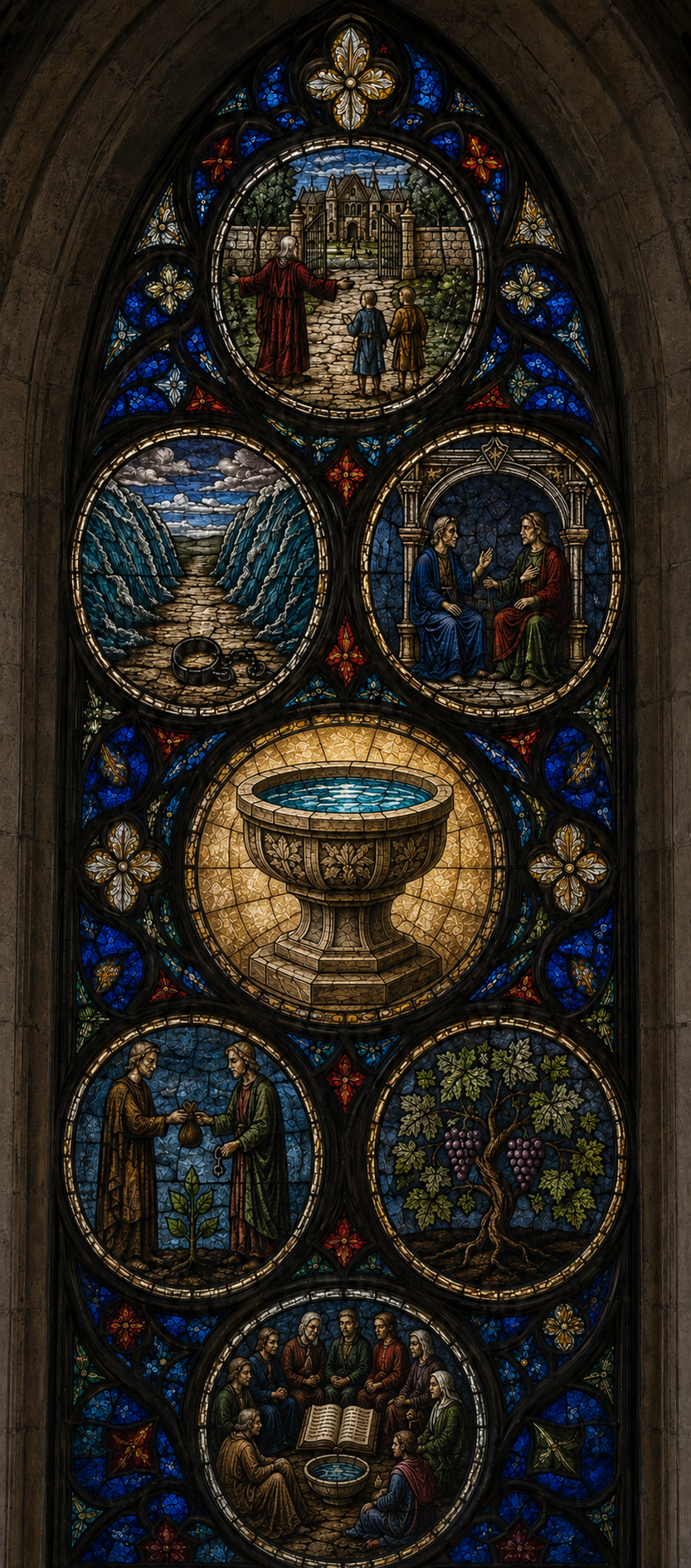
What might change if Presbyterians placed the Assurance of
Forgiveness before the confession of sin?
By Matthew J. Skolnik
A companion to Grace First. This essay offers the
biblical, Reformed, liturgical, and pastoral rationale behind the
six-conversation Grace First experiment. Explore the Grace First
series.
One Sunday, before inviting the congregation to confess its sin, I
offered the Assurance of Forgiveness:
“Before we name what we have done and left undone, hear the good
news: God’s mercy is not waiting for us to find the right words. In
Jesus Christ, God has already come near. In Jesus Christ, we are
forgiven. Nothing we confess can surprise God, and nothing we reveal can
make God less gracious. Trusting this promise, let us tell the truth
about ourselves and our world.”
Then we confessed our sin.
No one commented afterward. No one said the service felt
revolutionary. Yet while presiding, I felt joy and celebration. I felt
that we had made a safe place for God’s people to heal—not safety from
the truth about ourselves, but safety for the truth. The confession
itself felt less perfunctory. It was no longer a ritual obstacle we had
to clear before grace could be announced. It became a response to grace
already given.
Every congregation gathers people in different spiritual places. Some
come from habit, their words moving faster than their attention. Some
arrive wounded, already carrying more accusation than they can bear.
Some come confident that sin is mainly a problem in other people. Grace
speaks to all three. It awakens the habitual, shelters the wounded and
disarms the self-righteous. Then it invites all of us to tell the
truth.
The question our order
raises
In most Presbyterian services, the sequence is familiar: call to
confession, prayer of confession, perhaps a Kyrie—“Lord, have mercy”—and
then what many congregations call the Assurance of Forgiveness and the
PC(USA) Directory for Worship calls the Declaration of Forgiveness. The
language varies, but the grammar is remarkably stable: we confess, and
then forgiveness is declared.
That order need not teach bad theology. Grace has already appeared in
the call to worship, the opening hymn and the call to confession. The PC(USA)’s own explanation
of the order says that the invitation to confession assures us
of God’s mercy. It even states the theological point with admirable
clarity: “We have already been forgiven, and therefore, we freely
confess.”
But worship communicates not only through its words. Sequence also
speaks. When the clearest, most explicit proclamation—“In Jesus Christ,
we are forgiven”—regularly follows confession, worshipers can hear a
transaction the church does not intend: first we admit enough, feel
enough or say the right words; then God forgives. A well-crafted call to
confession may prevent that misunderstanding, but it asks a subtle
introduction to carry more theological weight than the order itself.
What if our enacted grammar matched our stated grammar? What if we
proclaimed forgiveness first, and then confessed because grace had made
honesty possible? Confession is not the door through which we enter
grace. Grace is the room in which honest confession becomes
possible.
A grammar older than our
order
Scripture repeatedly tells the story with God as the first actor. God
hears Israel’s cry and brings the people out of Egypt before giving the
commandments: “I am the Lord your God, who brought you out of the land
of Egypt” (Exodus 20:2). Deliverance precedes obedience. Paul does not
say that Christ died for us once we had repaired ourselves; “while we
still were sinners Christ died for us” (Romans 5:8). Even Jesus’
announcement, “The kingdom of God has come near; repent, and believe in
the good news” (Mark 1:15), grounds repentance in what God has already
brought near.
The parable of the prodigal son offers a particularly vivid
liturgical image. While the son is still far off, the father sees him,
runs to him, embraces him and kisses him. Only within that embrace does
the son speak his confession (Luke 15:20–21). The embrace does not
eliminate confession. It changes its setting. The son tells the truth
not to persuade the father to become merciful, but because mercy has
already run down the road to meet him.
The same pattern runs through the Reformed tradition. The Heidelberg
Catechism does not begin with human depravity. It begins with
comfort: I belong, body and soul, in life and in death, to my faithful
Savior Jesus Christ (4.001). Its next answer names sin, deliverance and
gratitude as the three things we need to know in order to live and die
in that comfort (4.002). Sin is taken seriously, but it is named inside
the prior reality of belonging.
Calvin makes the theological dependence even sharper. In Institutes
3.3.1, he writes that repentance “not only always follows faith,
but is produced by it.” He is not proposing a delay between believing
and repenting. He is naming an order of dependence: repentance grows
from receiving the grace offered in the gospel. In the next section,
Calvin interprets “Repent, for the kingdom of heaven is at hand” to mean
that repentance follows from the offer of grace and the promise of
salvation (3.3.2). Grace does not make repentance unnecessary. Grace
gives birth to repentance.
What, then, of the texts that join forgiveness to confession? First
John 1:9 says, “If we confess our sins, he who is faithful and just will
forgive us our sins.” The sentence matters, but it does not make the
quality of our confession the cause of mercy. The surrounding passage
has already located cleansing in the blood of Jesus (1:7), and it
immediately names Jesus Christ as our advocate (2:1–2). God forgives
because God is faithful, not because we have achieved a sufficient
degree of remorse. Likewise, Peter’s call to repent in Acts 2:38 follows
his proclamation of what God has done in the crucified and risen Christ
(2:22–36). The apostolic summons is urgent, but it is a response to
news. Placing assurance first does not reverse Scripture’s call to
repentance; it makes clear why repentance can begin.
Calvin’s liturgy—and
ours
Historical honesty matters here. Calvin did not place an assurance of
forgiveness before confession in the way I am proposing. He commends
ordinary corporate confession at the opening of worship and the
consolation of ministerial absolution in Institutes
3.4.11 and 3.4.14. Nor can we reconstruct every detail of a
single, pristine “Calvin liturgy.” His original French Strasbourg order
from 1539 or 1540 has not survived. Later Strasbourg texts are indirect
witnesses shaped by other hands, while the Genevan order of 1542 begins
with an opening word, confession of sin and a sung psalm before the
sermon. Alasdair Heron carefully traces this textual history in his
peer-reviewed study, “Shaping
the Worship of the Reformed Church in Geneva”.
So this proposal is not a campaign to restore Calvin’s exact service.
It is an experiment prompted by a tension within the inheritance.
Calvin’s theological order is faith giving birth to repentance; his
familiar liturgical order is confession followed by absolution. We
should acknowledge both facts.
Calvin also gives us a reason to examine the tension rather than
simply repeat an inherited form. In the “Letter to the Reader”
accompanying the 1542 Genevan order, he argues that worship must be
understood if it is to edify: people should know what its practices
contain, mean and intend so that their use is rightly ordered. Heron
reproduces the relevant passage and places it in its historical setting.
If an order of worship can be heard to say something other than we mean,
Reformed fidelity calls us to make the gospel more intelligible.
Our own constitutional standards make room for such discernment. The
Directory
for Worship says that an order of worship shapes faith and
faithfulness over time (W-3.0103). It calls its pattern “one commendable
model,” not an exclusive arrangement, and permits other patterns that
are faithful to the Word, open to the Spirit and dedicated to God’s
glory. The question is therefore not whether Presbyterians may ever
change a sequence. The question is what sequence most faithfully forms
people in the gospel we proclaim.
Covenant, not
contract
James B. Torrance described a persistent temptation in Christian
worship: turning covenant into contract. A contract begins with
conditions—if you perform, then the promised benefit follows. Covenant
begins with God’s promise and action, which awaken and sustain our
response. As Torrance put it, “the indicatives of grace always precede
the imperatives of law and obligation” (Worship, Community and the
Triune God of Grace, p. 70). An assurance placed after confession can be
heard contractually even when it is meant covenantally. Placing it first
makes the indicative audible before the imperative.
This is also what I mean when I say that Jesus is not “Plan B.” I do
not mean that sin is unreal or that salvation is unnecessary. I mean
that Jesus is not a divine emergency response to a creation that
defeated God’s original intention. Sin ruptures creation, but it does
not invent grace or frustrate God’s purpose. In the theology of T. F.
Torrance, God’s covenant purpose moves through Israel toward its
fulfillment in Jesus Christ, who embodies both God’s reconciling action
and humanity’s faithful response. Martin Davis documents this theme
across Torrance’s work in “The
Pre-history of the Incarnation of Jesus Christ in the Christology of T.
F. Torrance”.
That conviction changes the emotional posture of confession. We are
not trying to activate a reluctant mercy. We are being drawn into
Christ’s own truthful and healed humanity. We confess because God’s
grace has found us, claimed us and is making us new.
Safety for the truth
I have served people who learned in Christian communities to regard
themselves first as dirty, dangerous or fundamentally suspect. Some
carry religious shame into marriage and cannot experience their own
bodies or their spouse’s love without fear. Others carry shame around
addiction, anger, doubt, failure or mental illness. I do not want to
minimize sin. I want the church to distinguish conviction, which tells
the truth about what harms God, neighbor and self, from shame, which
tells a person that the whole self is unworthy of love.
Psychology cannot determine our theology, but it can help us notice
what our practices do. Research surveyed by June Tangney, Jeff Stuewig
and Debra Mashek distinguishes guilt focused on harmful behavior, which
can support repair, from global shame, which is more often associated
with hiding, defensiveness or withdrawal (“Moral
Emotions and Moral Behavior,” Annual Review of Psychology 58
[2007]). The distinction is not absolute, but it names a
pastoral danger. When people believe disclosure may cost them belonging,
they learn concealment. When they know mercy has already moved toward
them, they can risk the truth.
Changing one liturgical sequence will not heal trauma, undo spiritual
abuse or solve every distorted teaching about sin. Yet weekly worship
forms imagination through repetition. Over years, its order becomes a
story we carry in our bodies. The church should want that story to say:
You are not beyond the reach of grace. Therefore, you no longer need to
hide.
The font already
tells this story
Presbyterians already enact God’s priority whenever we baptize a
child. The Directory says that infant baptism witnesses to the truth
that “God claims people in love even before they are able to respond in
faith” (W-3.0402). God’s faithfulness is sure even when ours is not.
That is why the Directory connects confession and forgiveness to the
baptismal font (W-3.0205), and why PC(USA) worship resources say we
confess by claiming the promises sealed in baptism.
The font therefore offers both a place and a theology for this
experiment. For six or eight weeks, a congregation might begin its
confession from the font by proclaiming an actual Assurance—not merely a
gracious invitation:
“Before we name what we have done and left undone, hear the good
news: God’s mercy is not waiting for us to find the right words. In
Jesus Christ, God has already come near. In Jesus Christ, we are
forgiven. Nothing we confess can surprise God, and nothing we reveal can
make God less gracious. Trusting this promise, let us tell the truth
about ourselves and our world.”
Then let the people confess. Make room for silence. Sing “Lord, have
mercy,” not as an attempt to change God’s disposition, but as the prayer
of forgiven people who remain dependent on mercy and who cry out for a
wounded world. Follow with a song of gratitude, a call to new life or
the peace of Christ. The movement is grace, truth and gratitude.
The experiment should be accompanied by directed conversation with
the session, worship leaders and congregation. What story did the
sequence tell? Did prior assurance make confession less serious, or did
it make confession more honest? How was it heard by people carrying
shame? How was it heard by those more conscious of others’ sins than
their own? Invite Christians from other traditions, people who have left
churches and even neighbors who do not identify as Christian to listen.
They do not determine the church’s theology, but they can help us hear
what our worship communicates beyond our intentions.
Let grace speak
first
No one commented after the Sunday when I changed the order. I cannot
claim that everyone experienced the shift as I did. Liturgical formation
is usually quieter than that. But I felt joy. I felt the possibility of
a community in which people could face sin without being defined by it—a
community where the wounded were sheltered, the habitual awakened and
the self-righteous disarmed.
Taking sin seriously does not require us to make sin the first or
loudest word. The first word belongs to the God who creates, calls,
liberates and reconciles. The last word belongs to that God too.
We do not confess in order to become forgiven. In Jesus Christ, we
are forgiven; therefore, we can confess. Let grace speak first. Then,
within the safety of that grace, let us tell the truth.
Sources and further reading
Presbyterian
Church (U.S.A.), Directory for Worship, W-3.0103, W-3.0205 and
W-3.0402.Presbyterian
Church (U.S.A.), Book of Confessions, Heidelberg Catechism
4.001–4.002.John
Calvin, Institutes of the Christian Religion 3.3.1–2, trans. Henry
Beveridge.John
Calvin, Institutes of the Christian Religion 3.4.11 and 3.4.14, trans.
Henry Beveridge.James B. Torrance, Worship, Community and the Triune God of Grace
(InterVarsity Press, 1996), 70.
Keep exploring
More from this series
Before We Responded, God Acted
Receive the promise that God’s mercy moves toward us before we find the right words, and notice what becomes possible when grace speaks first.
Open resource →What Story Are Our Practices Telling?
Examine what our worship practices teach us about God, sin and grace—and whether their order tells the story we actually believe.
Open resource →Grace Makes Room for the Truth
Explore how assurance creates enough safety to tell the truth without minimizing harm or defending ourselves.
Open resource →