Formation · Conversation
What Story Are Our Practices Telling?
Grace First · Conversation 2 of 6
Scripture
The Words of the Covenant
1And God spoke all these words, saying, 2“I am the LORD your God, who brought you out of the land of Egypt, out of the house of slavery.
3You shall have no other gods before me. 4You shall not make for yourself an image, or any likeness of what is in the heavens above or on the earth beneath or in the waters under the earth. 5You shall not bow down to them or serve them, for I, the LORD your God, am a jealous God, visiting the iniquity of fathers upon children, upon the third generation and upon the fourth, of those who hate me, 6but showing steadfast love to thousands, to those who love me and keep my commandments. 7You shall not lift up the name of the LORD your God for emptiness, for the LORD will not hold guiltless the one who lifts up his name for emptiness.
8Remember the Sabbath day, to keep it holy. 9Six days you shall labor and do all your work, 10but the seventh day is a Sabbath to the LORD your God. You shall not do any work—you, or your son, or your daughter, your servant or your female servant, or your livestock, or the sojourner who is within your gates. 11For in six days the LORD made the heavens and the earth, the sea and all that is in them, and rested on the seventh day; therefore the LORD blessed the Sabbath day and made it holy. 12Honor your father and your mother, that your days may be long upon the land that the LORD your God is giving you.
13You shall not murder. 14You shall not commit adultery. 15You shall not steal. 16You shall not bear false witness against your neighbor. 17You shall not desire your neighbor’s house; you shall not desire your neighbor’s wife, or his servant, or his female servant, or his ox, or his donkey, or anything that belongs to your neighbor.”
Notes
Command is grounded in deliverance. Identity precedes obligation.
Exclusive allegiance is primary—no rival loyalties in the presence of the LORD.
The prohibition of images resists reduction of the divine to created form.
Misuse of the name is framed as emptiness—invoking God without weight or truth.
Sabbath remembrance orders time; holiness is embedded in rhythm.
Honor extends covenantal structure into the household, linking family and land.
Short prohibitions mark clear ethical boundaries—life, fidelity, property, truth.
Desire itself is addressed; the law penetrates interior intention, not only action.
Vocabulary
יָצָא (yāṣāʾ)
“To bring out.” To lead forth from constraint.
עֲבָדִים (ʿăḇādîm)
“Slavery/servitude.” Condition of forced service.
אֱלֹהִים (ʾĕlōhîm)
“God/gods.” Here, other divine powers.
פֶּסֶל (pesel)
“Carved image.” Idol formed by human hands.
נָשָׂא (nāśāʾ)
“To lift up.” To carry or invoke.
שָׁוְא (šāwʾ)
“Emptiness/vanity.” Worthlessness or falsehood.
זָכַר (zāḵar)
“To remember.” To actively keep in mind.
קָדַשׁ (qāḏaš)
“To make holy.” To set apart.
כָּבֵד (kāḇēḏ)
“To honor.” To give weight or significance.
רָצַח (rāṣaḥ)
“To murder.” Unlawful taking of life.
נָאַף (nāʾap̄)
“To commit adultery.” Violation of covenant fidelity.
גָּנַב (gānaḇ)
“To steal.” To take what is not given.
עֵד (ʿēḏ)
“Witness.” One who testifies.
חָמַד (ḥāmaḏ)
“To desire/covet.” To take pleasure in what belongs to another.
יָצָא (yāṣāʾ)
“To bring out.” To lead forth from constraint.
עֲבָדִים (ʿăḇādîm)
“Slavery/servitude.” Condition of forced service.
אֱלֹהִים (ʾĕlōhîm)
“God/gods.” Here, other divine powers.
פֶּסֶל (pesel)
“Carved image.” Idol formed by human hands.
Receive
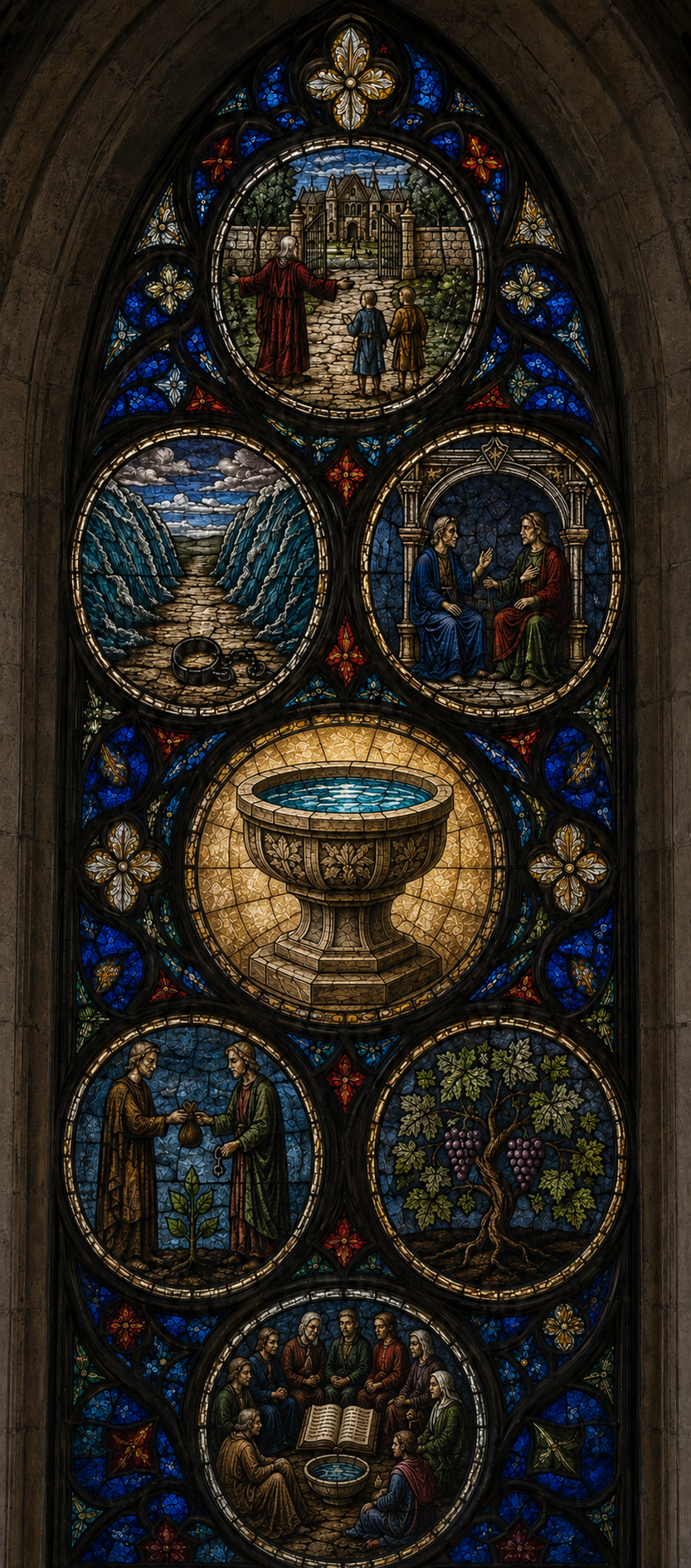
Before reading the commandments, hear the words that come first: God identifies Israel as the people brought out of Egypt and out of slavery. Liberation precedes instruction. The commandments matter, but obedience does not make God become Israel’s liberator. The law is given to a people whom God has already delivered.
Take a breath and hear the same gospel rhythm:
God acts with grace; we respond with gratitude. Grace has already arrived.
Notice
Every Christian community has a liturgy. Some liturgies are printed in bulletins and spoken from chancels. Others are informal patterns that have never been written down. A greeting, a familiar song, a certain kind of silence, the moment when people stand or sit—all of these teach us how to inhabit the Christian story.
Practices form us partly through repetition. Their meaning is not limited to what leaders intend or what a worship book explains. A repeated sequence can settle into the body as an expectation: this comes before that; this must happen before that can be said.
In the customary Presbyterian sequence, a call to confession, a prayer of confession and a declaration of forgiveness belong together. The current Directory for Worship explicitly says that confession is established on the promise of God’s grace and that the call to confession expresses God’s initiative. This is not a graceless order. Grace First asks a narrower question: What might become clearer if the full assurance were spoken before the confession itself?
Listen
Read Exodus 20:1–17. Listen especially to the relationship between the opening announcement and the commands that follow. God does not say, “Obey these commands, and then I will bring you out of Egypt.” God says, in effect, “I am the God who brought you out; therefore, learn to live as a free people.”
This does not make obedience optional. It places obedience inside a relationship initiated by God. Israel is not purchasing liberation. Israel is learning the shape of liberated life.
Try the two movements
Read the following movement slowly. Leave a brief silence between the sentences:
Trusting in God’s mercy, let us confess our sin. Silence. In Jesus Christ, we are forgiven.
Wait. Notice what story that movement tells in your mind and body. Do not decide whether it is right or wrong.
Now read the second movement at the same pace:
In Jesus Christ, we are forgiven. Silence. Trusting this promise, let us tell the truth about ourselves and our world.
Wait again. What changed, if anything? Did one movement feel safer, flatter, more serious, more familiar, more demanding or more freeing? Did either make you want to hide? Did either invite honesty?
There is no response that proves the experiment successful. Familiarity, personal history and the way the words are spoken all affect what we hear. The practice is to become attentive to the story carried by sequence.
Wrestle
Consider a repeated practice in your congregation, household or personal prayer. What does it teach beyond its stated meaning? What might a child, a wounded person or a first-time visitor reasonably imagine is happening?
If you are gathered with others, speak in observations rather than verdicts. Try “I noticed…” or “The sequence suggested…” rather than “Everyone knows…” or “This clearly means….” No person can speak for every worshiper.
You might explore these questions:
- What did each sequence make you imagine about God?
- What did each sequence make you imagine about yourself?
- Did grace spoken first weaken responsibility, or did it make responsibility easier to face?
- Whose experience might be different from yours?
Practice
Choose one familiar Christian practice this week and slow it down. It might be saying grace before a meal, passing the peace, making an offering, singing a familiar hymn or ending a prayer “in Jesus’ name.” Ask what story the practice tells through its words, timing and posture.
Write one sentence beginning, “This practice is teaching me that…” Do not worry yet about whether the sentence describes the practice’s intended theology. First notice the theology you are actually receiving.
Carry
When you encounter a command, obligation or invitation this week, ask what grace precedes it. Before “What must I do?” ask, “What has God already done, and what response is becoming possible?”
A prayer
Liberating God, you act before we understand and love before we respond. Make us attentive to the stories our practices tell. Where our worship obscures your grace, give us courage to learn. Where it bears faithful witness, give us gratitude. Form us into people whose obedience grows from freedom rather than fear. Amen.
Sources and further reading
Exodus 20:1–17; Book of Order (2025–2027), W-1.0102, W-2.0102 and W-3.0205; Heidelberg Catechism, Question 86; James B. Torrance, Worship, Community and the Triune God of Grace.
Keep exploring
More from this series
Let Grace Speak First
A biblical, Reformed, liturgical, and pastoral exploration of why grace makes truthful confession possible.
Open resource →Holding the Conversation
Optional guidance for creating a hospitable conversation in which participation is invited, silence is permitted and no ordained leader is required.
Open resource →Before We Responded, God Acted
Receive the promise that God’s mercy moves toward us before we find the right words, and notice what becomes possible when grace speaks first.
Open resource →